
When most people hear "virtual browser," they picture a security analyst detonating a suspicious link or a compliance officer protecting financial data. The real-world applications are far more creative. A Fortune 500 retailer runs virtual browsers for competitive price monitoring. A marketing agency spins them up for automated A/B testing at scale. An investigative team maps disinformation networks from disposable sessions to stay invisible to the operators they are tracking.
Virtual browsers are, at their core, a tool for isolation, consistency, and scale. Those three properties unlock a surprising range of applications far beyond traditional security. The more teams internalise that, the more creative they get about where browser isolation can replace expensive, manual, or risky workflows.
Ten virtual browser use cases you probably missed
Each of these works the same way under the hood. A disposable, isolated browser gives the team a repeatable clean room they would otherwise have to build themselves.
1. Competitive price monitoring at scale
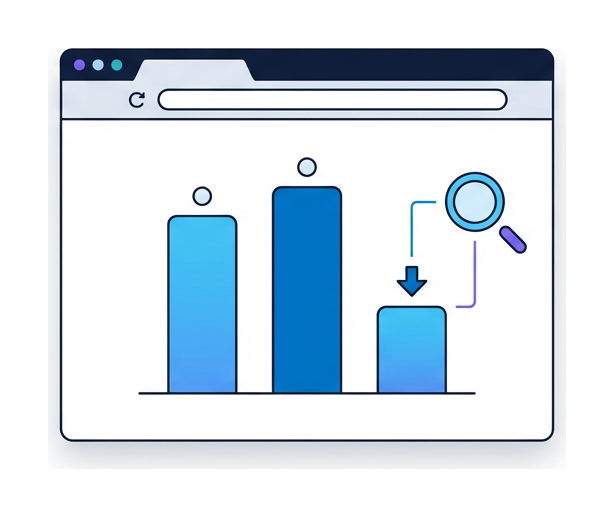
eCommerce companies use virtual browsers to monitor competitor pricing across hundreds of websites simultaneously. Manual price checking becomes obsolete when you can spawn a hundred browser instances in parallel, navigate each to a competitor site, and extract real-time pricing automatically. Each session appears from a different IP and device fingerprint, which prevents detection and rate limiting.
A major retailer we spoke with monitors 50+ competitor websites hourly, feeding prices, stock levels, and promotional data into their own pricing algorithm. The payoff is not the numbers themselves. It is that the pricing team trusts the feed, because the sessions look exactly like the ones their customers use.
2. A/B testing without affecting real users
Marketing teams test website variations before exposing them to real traffic. Fifty different checkout flows, landing page layouts, or call-to-action placements can run in parallel across isolated browsers. The results are clean, uncontaminated by real user behaviour, and do not require production traffic to generate.
One SaaS company tests 100+ variations of its signup flow this way. Automated scripts measure form completion, error frequencies, and drop-offs without any real user ever seeing the experiments. By the time a variant reaches production, it has already been validated against hundreds of synthetic sessions.
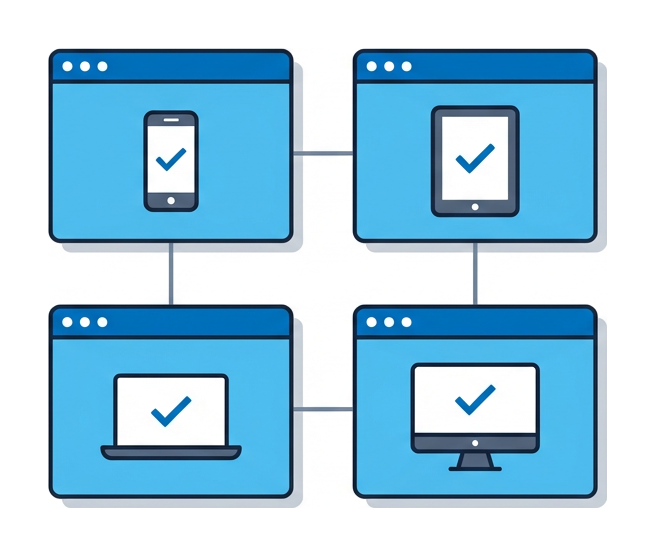
3. Cross-device and cross-browser QA
Instead of maintaining a rack of physical devices or paying for a cloud device farm, engineering teams use virtual browsers to test across dozens of device and OS combinations in parallel. One session appears as an iPhone running Safari, another as a Galaxy on Chrome, another as Windows 11 on Firefox. Developers get identical, reproducible environments on demand.
The cost delta is the real story. A web team that would have spent $200k on hardware and staff to maintain a device lab gets the same coverage for a fraction of the spend, and every pull request can trigger the full matrix.
4. Disinformation and influence-operation research
Journalists and researchers use virtual browsers to investigate coordinated disinformation without being detected. A normal browser accessing dozens of disinformation sites in sequence gets flagged and blocked. Virtual browsers, each with a different identity, let investigators map how narratives flow across coordinated accounts, forums, and fringe sites without tipping off the operators.
5. Localised content testing across regions
Global companies validate how their websites appear in different regions without travelling or juggling geolocation proxies. One session appears from Germany, another from Japan, another from Brazil, each with locally customised pricing, language, and messaging. Translators can review copy in context, and compliance teams can capture screenshots for sign-off without setting up anything.
6. Content scraping for market research
Market research firms collect pricing, availability, and content data from thousands of websites in parallel. A traditional scraper gets blocked after a few hundred requests. Virtual browsers look like legitimate users from different locations and devices, which keeps the data collection running and preserves the integrity of the dataset.
7. Legal eDiscovery and evidence collection
Law firms use virtual browsers to collect and archive evidence from websites that may disappear, change, or be deliberately modified. Each session creates an isolated, unmodified snapshot with timestamps, source URLs, and hashing metadata baked in. Evidence collected this way is easier to defend in court because there is no plausible path for local tampering.
8. API testing and load simulation
Engineering teams use virtual browsers as cheap load generators. A thousand sessions running end-to-end flows (login, browse, checkout) generate authentic traffic patterns and exercise the whole stack, not just the API endpoints. It is closer to how users actually behave than a synthetic load tool, and it surfaces the kinds of issues that only appear when JavaScript, auth, and database calls are all in play.
9. Accessibility testing at scale
Accessibility teams run WCAG validators across hundreds of pages in parallel. A government agency with 500+ web pages can verify Level AA compliance in minutes instead of days, and the violations land straight in Jira with screenshots and severity scores. The real upgrade is pairing automated scans with manual keyboard navigation inside the same isolated session, which catches the issues a scanner misses.
10. Social media bot and abuse research
Trust and safety teams investigate coordinated inauthentic behaviour by giving each persona its own virtual browser. Following 500+ suspicious accounts without their own research accounts getting flagged becomes tractable. Session recordings also preserve evidence, which matters when platforms or regulators need to see what the team actually observed.
The business impact, in numbers
Across the organisations we have worked with, the financial case for isolation tends to land on a few consistent numbers.
of enterprises using virtual browsers for non-security workloads
average annual savings from browser-based automation (Fortune 500)
reduction in manual QA labour on browser-heavy test suites
These numbers are averages, and averages lie. The point is not the exact figure. It is that the ROI pattern is consistent. Isolation and parallelism replace people, hardware, or both, and the payoff shows up quickly enough to survive a procurement review.
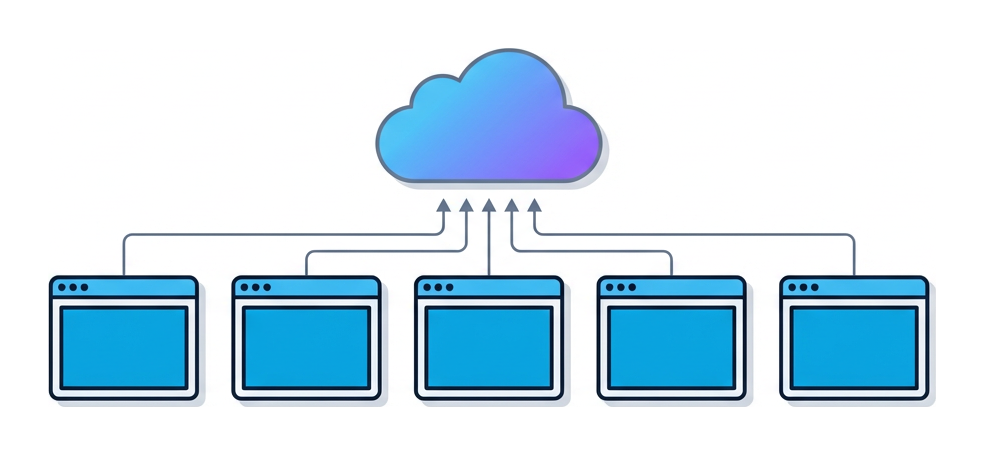
Where virtual browsers shine by industry
Different teams reach for browser isolation for different reasons. These short playbooks are useful when you need to align stakeholders or make the case internally.
Retail and eCommerce
The main workloads are competitive pricing, inventory and promotion monitoring, and localised merchandising validation. A secondary one is stress-testing checkout flows before seasonal surges, which is really just load testing dressed up as marketing work.
Professional services
Litigation evidence collection with preserved chain of custody, background research on prospects without leaving digital footprints, and parallelised market scans for client engagements. The common thread is that the browser is the artifact that leaves the firm, not a messy pile of downloaded files.
Media and research
Investigating disinformation networks, capturing geo-specific content before it is blocked or deleted, and collaborating with international bureaus in shared virtual workspaces. The disposable browser is both a research tool and a safety layer for the people using it.
Where to start
If you are picking your first project, weigh time-to-value against the effort required. Quick wins build momentum for broader adoption, so resist the urge to start with the hardest problem.
| Use case | Primary team | Time to value | Effort |
|---|---|---|---|
| Competitive price monitoring | Revenue operations | 48 hours | Low |
| Automated A/B testing lab | Growth and marketing | 1 week | Medium |
| Cross-browser QA grid | Engineering and QA | 2 weeks | Medium |
| eDiscovery capture vault | Legal | 2 days | Low |
| Threat research command centre | Security operations | 3 weeks | High |
A 30-day rollout blueprint
In the first week, interview finance, security, QA, and research teams to identify the workflows that either expose the company to risk or drain hours weekly. Do not start with solutions. Start with the actual time sinks people already complain about.
In the second week, provision Browser.lol sessions for five to ten power users across those teams. Write a short quick-start and collect both qualitative feedback and time-saved metrics. The goal at this stage is believers, not coverage.
In the third week, integrate the service into SSO, logging, and the workflow tools people already use (ticketing, SOAR, chat). Automate the repetitive jobs you found in week one, since that is where the numbers come from.
In the fourth week, roll out to adjacent teams, share an ROI-focused summary with leadership, and add Browser.lol to the onboarding playbooks so new hires adopt it by default. If you skip this step, adoption plateaus and you end up with a high-leverage tool that only power users know about.
Beyond security
When we think of virtual browsers, we default to security: suspicious links, financial data, defence against phishing. That is one application. Isolation, consistency, and scale are the more general properties, and they apply to almost any workflow that involves interacting with the web.
The organisations making the most of browser isolation in 2025 are the ones that stopped thinking of it as a security control and started treating it as a generic primitive. A clean, disposable environment you can spin up on demand, from any team, for any purpose. Once you see it that way, the list above starts to feel like a sample, not a ceiling.
Ready to unlock desktop power on any device?
Try Browser.lol free and experience true mobile productivity.
Start Your Desktop BrowserNo downloads required • Works on any device